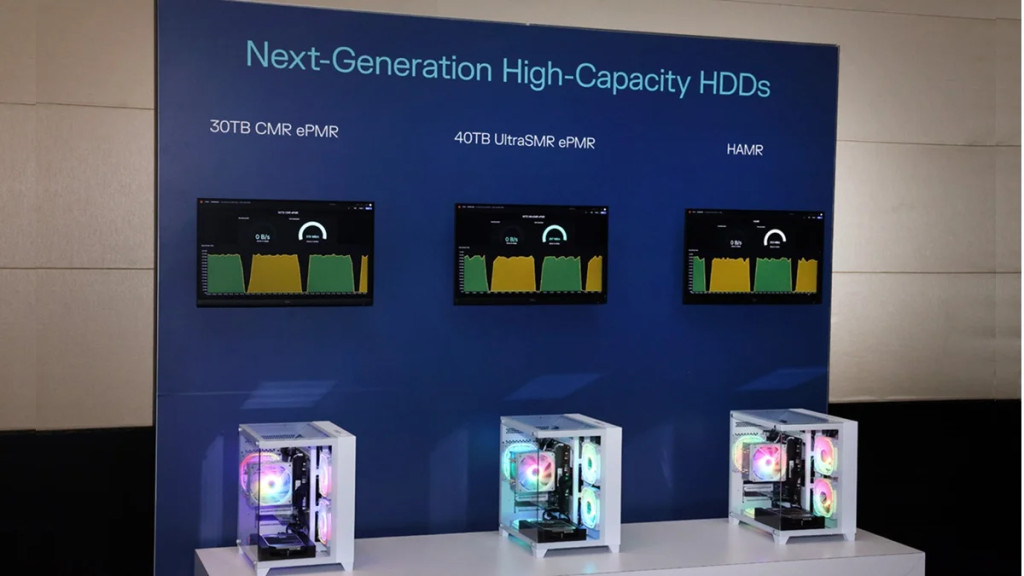
Set aside the world of instant cloud for a moment. Western Digital has just unveiled a data storage vision for the future that will make your head spin, especially for those of us living in the era of the AI explosion. Imagine: hard disk drives (HDDs) capable of holding over 100 Terabytes! This isn’t just an upgrade; it’s a revolution.
Ambitious Roadmap: Towards 100+ TB and Beyond
At Innovation Day 2026, Western Digital (WD) was not playing around. They presented a highly aggressive roadmap to address the data hunger of the Artificial Intelligence (AI) era. The primary focus is clear: how can storage technology remain relevant, even becoming the backbone for the rapidly evolving AI innovations?
Two Frontrunners: ePMR and HAMR Lead Extreme Capacity
How does WD plan to achieve these extraordinary storage capacities? The answer lies in two core technologies they master and continue to develop: ePMR (Energy-Assisted Magnetic Recording) and HAMR (Heat-Assisted Magnetic Recording). These are not just technical jargon; they are the keys to unlocking previously unimaginable capacities.
- 40 TB ePMR UltraSMR HDD: The Current King. WD claims this is the highest capacity HDD currently on the market. The good news is that this product is already in the qualification phase with two hyperscale giants (companies providing large-scale cloud infrastructure), and mass production is set to begin in the second half of 2026. This means super-large storage solutions are just around the corner.
- HAMR HDD: The Next, More Powerful Generation. Not stopping there, WD is also pushing HAMR technology. Its qualification is also progressing smoothly with two hyperscale customers, and we can expect to see increased production in 2027.
Dual-Path Strategy: Flexibility and Efficiency
WD is not choosing just one technology. Instead, they are employing a dual-path approach, strengthening ePMR to a target of 60 TB by leveraging HAMR innovations without sacrificing power efficiency. Meanwhile, HAMR technology will be pushed to an astonishing 100 TB capacity by 2029.
The selection of this strategy is not without reason. Both technologies are built on the same architecture, which means efficiency in manufacturing, improved production yields, and a smoother product transition. For hyperscalers, this provides the flexibility to choose the technology that best suits their specific needs, while also receiving assurance of predictive capacity planning and sustainable scalability.
AI Workload Optimization: Faster, More Efficient
Large capacity alone is not enough. To ensure AI workloads run optimally and reduce reliance on more expensive flash storage, WD is introducing two crucial innovations:
- High Drive Bandwidth Technology: This is about making data flow faster to and from the drive.
- Dual Pivot Technology: Enhances the accuracy of read/write head movements, which is crucial for fast and precise data access.
The combination of these two technologies is claimed to increase sequential IO by up to 4 times. Importantly, this maintains excellent IO per Terabyte performance, even on 100 TB HDDs. Not only that, but these drives will also be optimized to save up to 20% in power consumption. WD is targeting data access of less than one second for AI workloads, while maintaining the standard 3.5-inch form factor for easy integration into existing infrastructure.
This is a significant step that demonstrates Western Digital’s commitment not only to follow the AI trend but also to be its driver. With an aggressive capacity roadmap and focused technological innovation, they are ready to provide a robust storage foundation for an AI-driven future.