Entering mid-2025, Apple’s artificial intelligence (AI) roadmap has materialized with the launch of Apple Intelligence. Unlike some competitors’ approach, which focuses on a single, gigantic language model (LLM), Apple takes a deep integration path, combining on-device AI processing with a private and efficient cloud infrastructure. This strategy is not merely a technological adjustment, but a new foundation for more personal, relevant, and secure user interactions.
The Hybrid Approach: On-Device and Private Cloud Compute
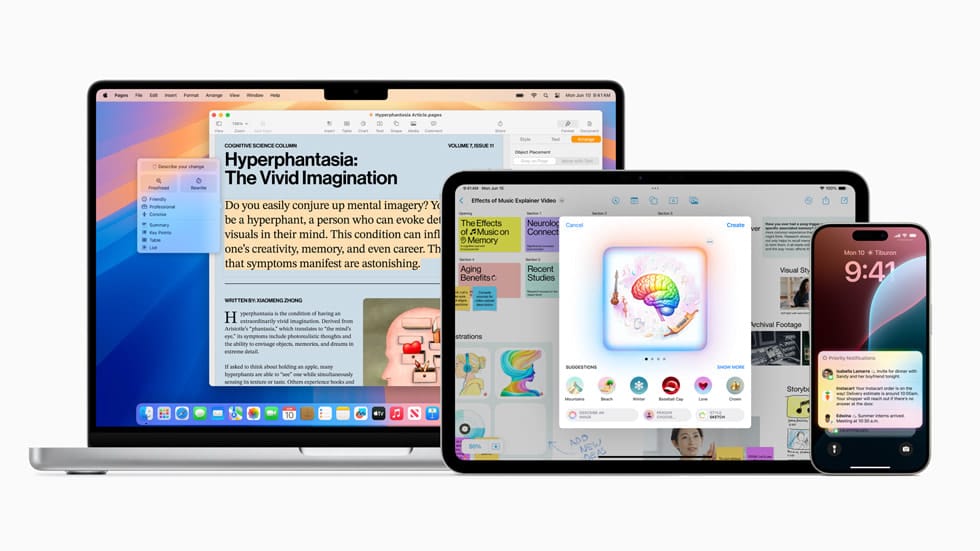
At the heart of the Apple Intelligence strategy is a hybrid architecture. Lightweight and privacy-sensitive AI features, such as text refinement, Genmoji creation, or notification settings, are processed directly on the Apple Silicon chip in the user’s iPhone, iPad, or Mac. Why is this important? On-device processing ensures maximum privacy for personal data and reduces latency, enabling instant AI responses without having to send sensitive information to external servers. This reinforces Apple’s commitment to user data security as a top priority.
However, for AI tasks that require massive computing power and more complex models, the device will automatically and securely utilize Apple’s Private Cloud Compute (PCC). This is a crucial breakthrough that ensures scalability without sacrificing privacy principles. User data sent to the PCC is end-to-end encrypted, and the system is designed with a zero-knowledge proof architecture, meaning Apple itself cannot access the data. Why is this important? With PCC, Apple can offer advanced AI capabilities such as summarizing long documents or creating complex images, while still maintaining user trust that their data is not stored or used for model training without explicit consent.
Innovation in Apple Silicon-Specific Server Chips
A key pillar behind Private Cloud Compute is the development of dedicated server chips based on the Apple Silicon architecture. Similar to how the M-series chips have revolutionized performance and power efficiency on Macs and iPads, these server chips are specifically designed to handle AI workloads in data centers with optimal energy efficiency and performance. Why is this important? With full control over the technology stack, from chip design to software implementation, Apple can optimize the entire ecosystem for superior AI performance, unmatched security, and long-term operational cost efficiency. This allows Apple to maintain full control over its cloud infrastructure, avoiding dependence on third-party vendors who may have different privacy standards.
Smarter and More Personal AI Integration
For users, Apple Intelligence, embodied through this hybrid approach, means an AI experience that feels faster, more responsive, and, most importantly, very personal. Features such as Siri, which is now more contextual and capable of understanding natural commands, the ability to create Genmoji based on text descriptions, or sophisticated writing tools to refine text in various applications, all work seamlessly in the background. In addition, optional integration with third-party models such as OpenAI’s ChatGPT, recently introduced, demonstrates Apple’s flexibility in offering broader LLM capabilities, but still within the user’s full control and with strong privacy guarantees. Why is this important? This gives users choice and access to advanced AI capabilities without forcing them to leave the Apple ecosystem or sacrifice their privacy.
Implications of This Strategy for the Apple Ecosystem
The Apple AI strategy, introduced with Apple Intelligence, confirms that the future of AI, according to Apple, is not about flaunting raw computing power, but about smart integration that provides real benefits in everyday life while prioritizing privacy. By not relying too heavily on third-party data centers that do not have full control over their infrastructure, Apple strengthens its position as a leader in user-centric and privacy-focused innovation. By July 2025, this strategy has shifted from concept to reality, fundamentally changing the way billions of users interact with their Apple devices, setting a new standard for responsible and empowering AI.