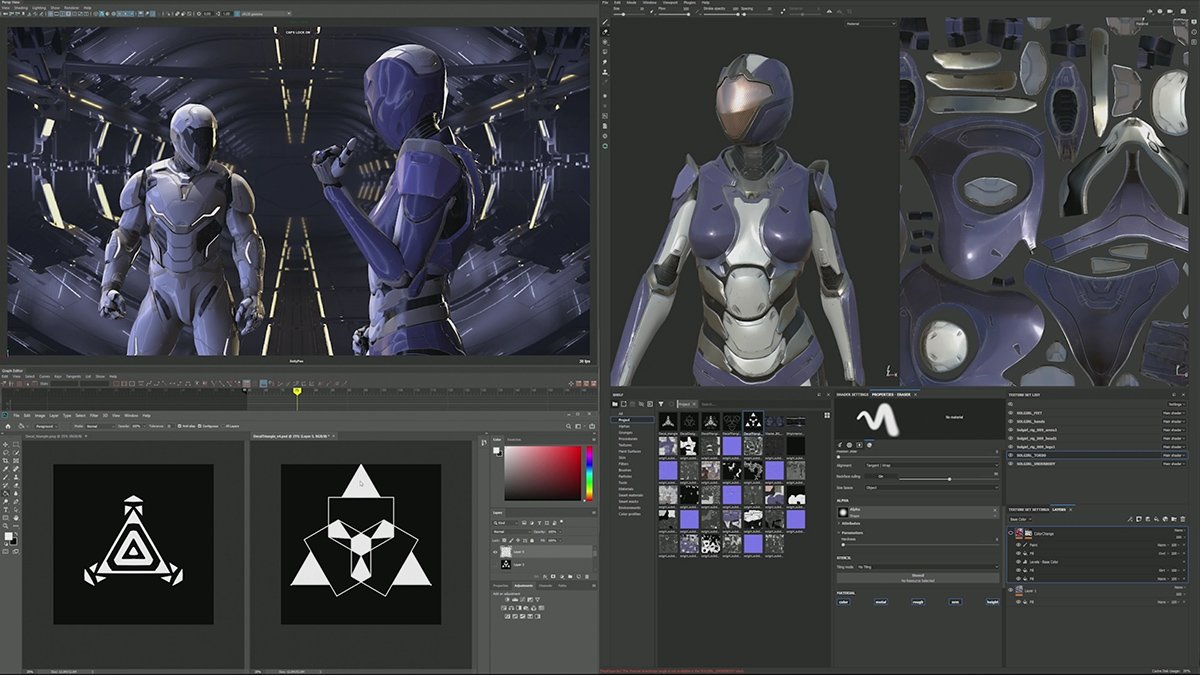
When rendering 3D, the highest workload indeed lies on the CPU (processor) and GPU (VGA) components. Although the GPU plays a large role in accelerating rendering, the CPU remains the main component that handles many processes.
However, as a general guide, GPU rendering is best if you want faster render times or more realistic images. CPU rendering is better for larger scenes, more accurate results, and access to more features and plugins. To save money on hardware, investing in GPU rendering is the right way to go.
Processor Recommendations for 3D Rendering
To ensure optimal 3D rendering performance, here are some capable processor specifications:
- AMD Ryzen 9 5950X
- Cores/Threads: 16/32
- Base Clock: 3.4 GHz
- Boost Clock: 4.9 GHz
- Cache: 64 MB L3
- TDP: 105W
- Intel Core i9-12900K
- Cores/Threads: 16/24
- Base Clock: 3.2 GHz
- Boost Clock: 5.2 GHz
- Cache: 30 MB L3
- TDP: 125W
- AMD Ryzen Threadripper 3960X
- Cores/Threads: 24/48
- Base Clock: 3.8 GHz
- Boost Clock: 4.5 GHz
- Cache: 128 MB L3
- TDP: 280W
- Intel Core i7-12700K
- Cores/Threads: 12/20
- Base Clock: 3.6 GHz
- Boost Clock: 5.0 GHz
- Cache: 25 MB L3
- TDP: 125W
Best VGA Recommendations for 3D Rendering
In the world of 3D rendering, choosing the right Video Graphics Adapter (VGA) is very important. Although the VGA does not directly affect the rendering process, this component still plays a large role in the editing process. Therefore, here are the best VGA recommendations that you can consider for 3D rendering.
- Nvidia GeForce GTX 1660 Super
Nvidia GeForce GTX 1660 Super comes with 6GB of memory and 123W of power. This VGA supports floating point operations, making it very suitable for 3D rendering. Its performance is 20% faster than its predecessor, and its power efficiency is also better, making the video editing process faster and smoother. Memory: 6GB GDDR6. TDP: 125W. - ASUS ROG Strix Radeon RX 6700 XT OC Edition 12GB GDDR6
Known as a VGA designed for gaming, the ASUS ROG Strix Radeon RX 6700 XT also excels in rendering. With three axial technology fans and an optimal heatsink, this VGA guarantees good air circulation, increasing performance during 3D rendering. The ASUS GPU Tweak II feature allows you to adjust GPU performance, including core clocking, memory frequency, and voltage settings. Memory: 12GB GDDR6. TDP: 230W. - GIGABYTE AORUS GeForce RTX™ 3060 Ti ELITE 8G
GeForce RTX™ 3060 Ti offers extreme overclocking with low temperatures. This VGA is very efficient for 3D rendering, with a power design that helps MOSFETs work better in various temperature conditions. In addition, the RGB Fusion feature allows you to customize the lighting according to your needs. Memory: 8GB GDDR6. TDP: 200W. - MSI Radeon RX 6600 XT MECH 2X 8G OC
The MSI Radeon RX 6600 XT MECH 2X has extra protection against the risk of short circuits, thanks to the copper layer that functions as a conductor in the PC. This VGA is not only reliable for 3D rendering, but also durable, so it can be relied on for the long term. Memory: 8GB GDDR6. TDP: 160W.
Repiw’s Conclusion:
In 3D rendering, both CPU and GPU have a crucial role. For the best results, make sure both components have capable specifications. A processor with many cores and threads, as well as a GPU with high memory capacity and good power efficiency, will ensure the rendering process runs smoothly and quickly.