Building a PC is a lot of fun. Choosing the processor, VGA, RAM—it feels like being an engineer. But there’s one component that novice builders often overlook, even though it plays a crucial role: the PC case. Many people think, “Ah, what matters is the components inside. The case just needs to fit.” Well, this is a big misconception.
A case isn’t just a ‘box’ to hold the components. The case is the home, backbone, and breathing system for your PC. Choosing the wrong case can cause your expensive components to overheat, become noisy, and be difficult to upgrade later on. I’ve experienced building in a bad case, and I swear, it was traumatic. Therefore, I want to share a guide so you don’t repeat the same mistakes.
1. Size Matters: Full Tower, Mid Tower, or Mini-ITX?
First, you have to determine the case size, and this depends on the size of the motherboard you choose. The three most common sizes are:
- Full Tower: This is a monster. Very large, heavy, but the space is super spacious. Suitable for those who want to use an E-ATX motherboard, install a complicated custom water cooling system, or want to put in a dozen hard drives. For most people, this is overkill.
- Mid Tower: This is the most popular and ‘safe’ size for the majority of PC builders. The size is just right, not too big, and can accommodate ATX (standard), Micro-ATX, and Mini-ITX motherboards. The model selection is also the most extensive. If you’re confused, start here.
- Mini-ITX (SFF – Small Form Factor): This is for those who like cute, compact, and easy-to-carry PCs. This SFF case is very small, but building inside is a challenge in itself. The space is tight, so cable management and airflow must be carefully considered. You also have to use a Mini-ITX motherboard and often need special components like an SFX PSU.
2. Airflow, Airflow, and Airflow!
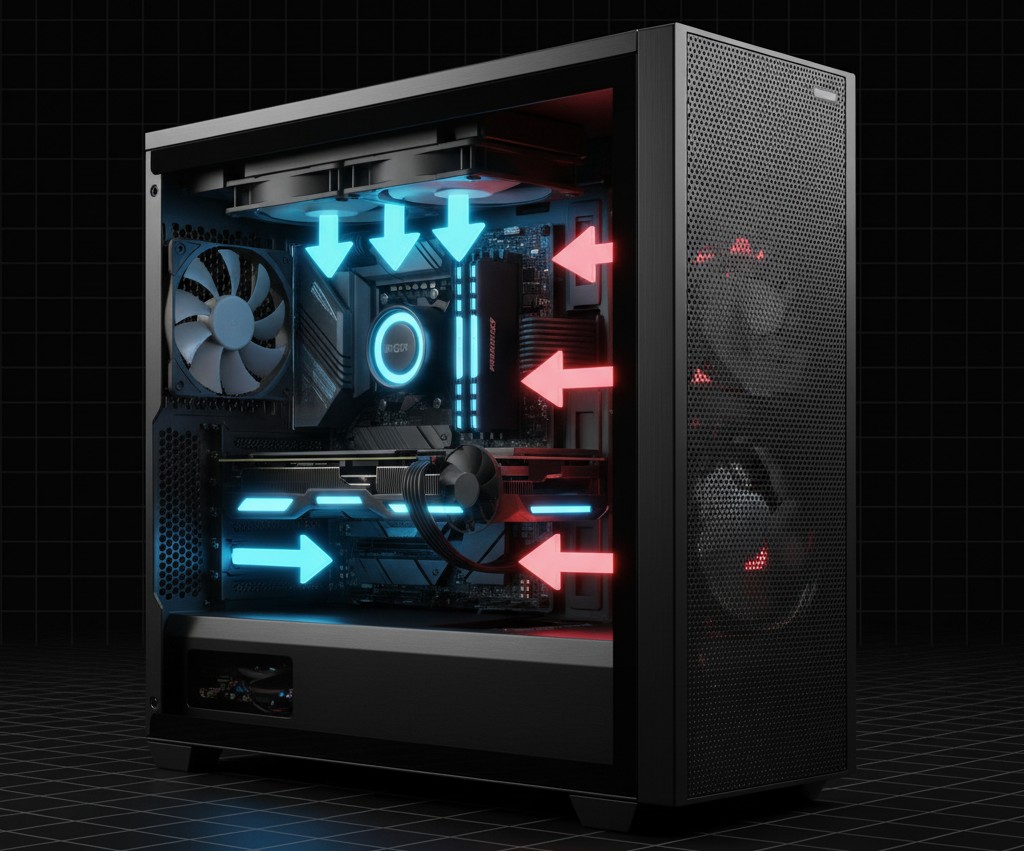
This is the most important factor that separates a good case from a bad case. PC components generate heat. The case’s job is to ensure smooth air circulation to ‘kick’ hot air out and ‘suck’ cold air in. How do you assess it?
Pay attention to the front panel. Cases with a mesh front panel are the airflow champions. Cold air can enter directly without obstruction. Avoid cases with a front panel that is tightly covered with glass or acrylic just for aesthetics. It might look cool, but it’s like ‘choking’ your own PC. The components inside will ‘sweat’ and their performance can decrease (thermal throttling).
You’ll also like this: also pay attention to fan and radiator support. A good case provides many slots to add fans at the front, top, and back. This gives you the flexibility to arrange the optimal airflow (usually, front and bottom are intake/in, back and top are exhaust/out).
3. Cable Management Isn’t Just About Neatness
Tangled cables inside a PC aren’t just unsightly. The cables can hinder airflow. A good case is designed with cable management in mind.
Look for these features:
- Space Behind the Motherboard Tray: There must be enough space behind where the motherboard is installed to ‘hide’ thick cables from the PSU.
- Cutouts (Cable Holes): Holes in strategic positions for cable paths from back to front. Even better if there are rubber grommets to keep it neat.
- Tie-down Points: Points to tie cables with cable ties to keep them in place.
- PSU Shroud: A closed compartment at the bottom of the case to cover the PSU and the remaining tangled cables. This makes the main part of your build look super clean.
4. Additional Features That Make Life Easier
Finally, pay attention to the material quality and small features that are very helpful:
- Dust Filters: Must have! Especially in the intake (front, bottom, top). These filters are easy to remove and clean, and will keep your components free from dust that can clog the heatsink.
- Front I/O Panel: Make sure the ports provided suit your needs. USB 3.0 ports are standard. Even better if there is a USB Type-C.
- Tool-less Design: A design that allows you to open the side panels or install hard drives without needing a screwdriver. Very practical.
Choosing a case is a long-term investment. You might replace the internal components every few years, but a good case can last for several upgrades. Don’t be stingy in this area. Many cases costing around 1 million now offer the premium features above. Do your research, watch reviews on YouTube, and choose the best ‘home’ for your favorite components.