Hey Indonesian internet dwellers, especially those who love tinkering with gadget specs late into the night, let’s be honest for a moment. Every year, new TVs arrive promising heavenly picture quality. But every time you open a catalog or listen to a salesperson, it feels like you’re hearing a magic spell: OLED, QLED, Mini-LED. It makes your head spin, right? What’s the point of having eyes if you can’t see the crisp visuals, but then you’re confused about which to choose?
I, having experienced the burnout of several CRTs and sighed at power-hungry plasma screens, totally understand your frustration. Here, we won’t engage in nauseating marketing jargon. We’ll break it down directly, using our brains and eyes, to see which TV technology is truly worth buying in 2025.
OLED: The Deep Black That Keeps You Awake
Okay, let’s start with the most glamorous, OLED. Think of it as the rockstar of the screen world. Why? Because each pixel has its own light source. Imagine millions of tiny lights that can be turned on and off at will. When asked to display black, this pixel truly goes dormant, emitting no light whatsoever. The result? The blackness is incredibly deep, like a moonless night in the middle of nowhere. This is what gives it ‘infinite’ contrast, unmatched by anything else.
So, can you imagine how it feels to watch horror or sci-fi movies with plenty of dark scenes on an OLED? Utterly chilling! Furthermore, because the pixels can activate instantly without delay, the response time is lightning-fast. Playing competitive games or watching fast-paced football matches? Guaranteed there’s no ghosting or stuttering images.
Its viewing angle performance is also a champion. Want to lounge in the corner of the sofa at an angle? The colors remain stable, unlike old TVs where the picture gets weird when viewed from the side.
The Catch?
But nothing is perfect, right? This rockstar has a significant drawback that can make you nervous: the risk of burn-in. If you constantly leave your TV on displaying the same channel logo for hours every day, or if the game’s UI stays stuck on the screen, then those organic pixels might ‘wear out’ and leave a permanent mark. Manufacturers have many tricks to prevent this, but the risk is still there.
Another thing is brightness. Compared to other technologies, OLED can’t quite match them when it comes to making the screen dazzlingly bright. So, if your room is like a football stadium with bright lights, OLED might not be your first choice.
Review Verdict
If you’re a true cinephile, love watching movies in dimly lit rooms, and prioritize breathtaking picture quality, OLED is king. Clearly.
QLED: The Bright Champion That’s Not Afraid of Smudges
Don’t be fooled by the name similarity to OLED; QLED tells a different story. QLED is essentially an evolution of regular LED-LCD TVs, but with an added ‘vitamin’ in the form of a quantum dot film layer. Imagine quantum dots as makeup artists for the light from the LEDs behind the screen. Blue light from the LEDs is converted into incredibly pure red and green colors, resulting in a wider and more accurate color spectrum. This is what makes QLED a champion in color volume – the colors remain sharp and don’t fade even when the screen is pushed to its highest brightness levels.
For those whose rooms are directly exposed to sunlight or who simply love ‘pop-up’ and vibrant images, QLED is a great option. Its brightness can be incredibly powerful, perfect for HDR content with many highlights. And good news for those worried about burn-in: QLED is completely immune. You can display a channel logo all week, and it’s no problem.
Where Does It Fall Short?
Well, as an evolution, it can’t quite beat a revolution. Since QLED still uses LED backlighting, it can never achieve absolute black like OLED. There’s always a slight light ‘leakage,’ so in a very dark room, QLED’s black might appear as dark gray.
The viewing angle is also similar. If you’re only watching with one or two people directly in front, it’s fine. But if it’s a crowd, those sitting on the sides might experience a slight decrease in picture quality.
Review Verdict
For those who often watch in bright rooms, love ‘wow’ colors, and don’t want to worry about burn-in risks, QLED is a very solid choice. The price is also usually more budget-friendly.
Mini-LED: The Smart Bridge Between Two Worlds
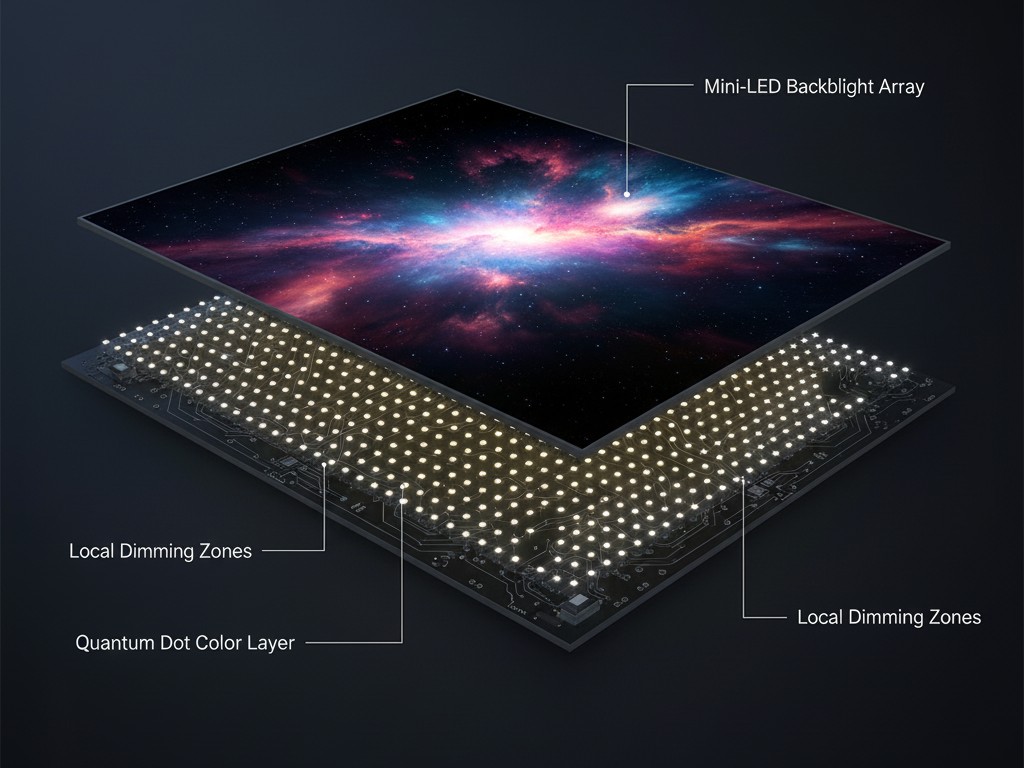
Now, this is interesting. Mini-LED isn’t a new panel technology, but a revolution in its backlight. The concept is simple: instead of using dozens or hundreds of large LEDs, Mini-LED uses thousands of much smaller LEDs. These mini LEDs are grouped into hundreds or thousands of local dimming zones. This is like having many ‘dimmers’ that can independently control how bright or dim different parts of the screen are.
What’s the effect? Dark areas? They can be dimmed or turned off. Bright areas? They can be pushed to maximum. The result is a drastic increase in contrast, and the ‘blooming’ effect (like halos around bright objects) that often plagues regular LCD TVs is significantly reduced. Mini-LED can be considered a ‘best of both worlds’ technology. It brings the brightness and color volume of QLED, but with contrast control that approaches OLED levels. Plus, it’s burn-in free.
Review Verdict
If you’re torn between QLED’s brightness and OLED’s black quality, but don’t want to risk burn-in, then Mini-LED is like the answer to your prayers. It’s a powerful all-rounder option for various scenarios.
So, Which One Hits the Hardest for You?
Okay, this is the most important part. There’s no single technology that fits everyone. So, let’s make a smart decision:
- Choose OLED if your top priority is the most authentic cinematic experience, you love watching in dark rooms, and you don’t mind being ‘a little’ more careful about static content.
- Choose QLED (non-Mini-LED) if you watch in bright rooms, love extremely vibrant and bright colors, and want to be ‘safe’ from all kinds of pixel damage risks.
- Choose a TV with Mini-LED (usually QLED) if you want the best combination of both: QLED’s fierce brightness plus enviable contrast, all while being safe from burn-in. This is often the most versatile option on the market right now.
In essence, don’t just get swayed by jargon. Think about your viewing habits, your room conditions, and your budget. Hopefully, this short guide will help you make the right choice and get a TV that truly makes you feel at home. Happy TV hunting!