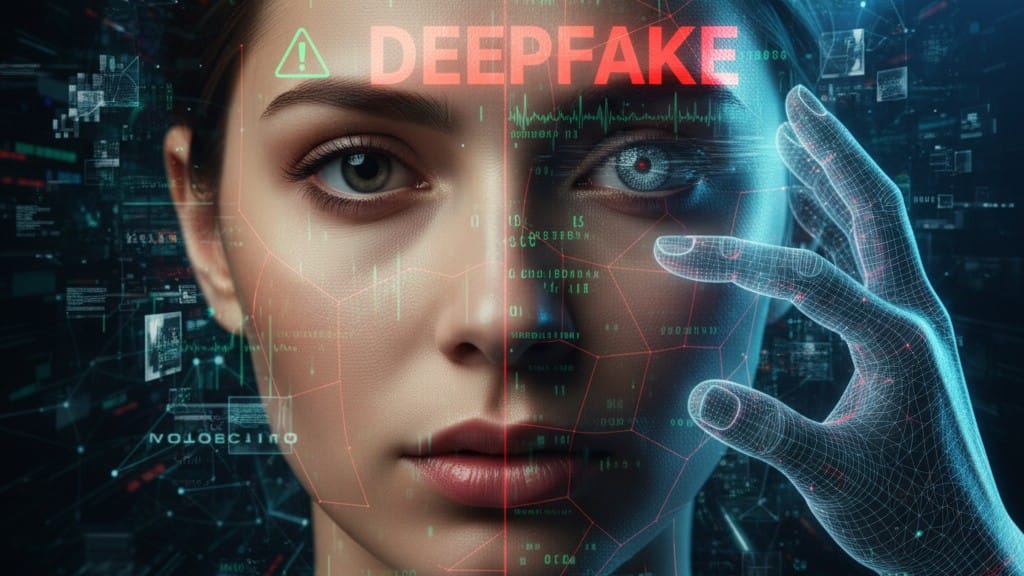
Welcome to an era where our own eyes and ears can become enemies in disguise, or rather, victims of sophisticated manipulation by artificial intelligence. As a practitioner with over two decades of experience in the IT infrastructure and cybersecurity arena, I see the evolution of deepfake technology not just as a fleeting trend, but as a fundamental paradigm shift in information integrity. By September 2025, deepfakes have surpassed the confines of laboratory experiments, becoming a potent weapon poised to erode public trust, fuel massive disinformation, and facilitate sophisticated fraud that causes both financial and reputational damage. It’s no longer about ‘recognizing’ visually, but about ‘validating’ every piece of visual and audio information we receive. The question is no longer ‘is it a deepfake?’, but ‘how can we ensure its authenticity?’
Anatomy of a Deepfake: The Evolution of Visual and Audio Threats
In the past, deepfakes might have looked like amateurish forgeries with obvious distortions. However, thanks to rapid advancements in Generative Adversarial Networks (GANs) and, especially, Diffusion Models, this technology has reached a level of near-perfect realism. GANs work with two competing neural networks—one that creates (the generator) and one that evaluates (the discriminator)—to produce increasingly convincing outputs. Diffusion Models, on the other hand, learn to create images or videos from ‘noise’ gradually, generating incredibly realistic and temporally consistent details.
So, why is this important? Because its impact pervades every aspect, from individual reputations to political stability and the integrity of financial markets. A deepfake can become a divisive political propaganda tool, a corporate disinformation campaign to discredit opponents, or even a trigger for mass panic. In the context of IT infrastructure, deepfake audio can be used in highly convincing spear phishing schemes, imitating a CEO’s voice to order illegal fund transfers (the ‘CEO fraud’ version 2.0).
Myths & Reality: Deepfake Indicators (That Are Fading)
A few years ago, we could rely on some ‘hallmarks’ to detect deepfakes. However, by 2025, most of these signs have been corrected by increasingly intelligent AI algorithms:
- Unnatural Eye Movements & Blinking: Previously, AI often failed to replicate natural blinking. Now, newer models have learned to mimic it well. Even so, observe the pupil patterns or light reflections on the cornea; minor inconsistencies can be a clue, as replicating complex optical physics is still a challenge.
- Stiff or Inconsistent Facial Expressions: Current AI models can produce far more dynamic facial expressions. Focus on micro-expressions or transitions between emotions. Are there very subtle pauses or stiffness as expressions change? Are the emotions displayed truly synchronized with the context of the conversation?
- Mismatched Lips & Audio: Lip synchronization (lip-sync) has also greatly improved. The current challenge is to find audio artifacts, such as inconsistent background noise or voice intonation that sounds monotonous or robotic, especially in unusual words or phrases.
- Strange Visual Artifacts: Blurred facial borders or inconsistent lighting around patched areas (such as the edges of hair or ears) can still occur, but they are becoming increasingly rare and subtle. Pay attention to the consistency of lighting and shadows throughout the scene, as well as skin texture that may be too smooth or unrealistic.
- Physiological Discrepancies: Non-verbal biometric detection such as inconsistent pulse or breathing with body movements, or even the absence of pupil dilation when light changes, are advanced indicators that AI still struggles to perfectly imitate.
Why are these indicators important? Because they demonstrate the computational limitations and training data of AI. AI, no matter how intelligent, still learns from existing data and replicates patterns, not intrinsically understanding the physics of the real world.
Building a Digital Fortress: Proactive Strategies Against Information Manipulation
Given the increasing difficulty of detecting deepfakes visually, our protection strategies must evolve from reactive to proactive, integrating strong digital literacy and technology.
Content Verification: Beyond Human Perception
- Be Critical of Source & Context: Always start with the questions ‘Where did this come from?’ and ‘Why am I seeing this?’. Unknown sources or content that elicits strong emotions should always be treated with caution. Cross-verify with reputable news media with a proven track record.
- AI Detection Technology: The market has begun to provide AI solutions for deepfake detection. While not a silver bullet, these platforms can analyze metadata, digital patterns, and anomalies that escape the human eye. Organizations and individuals with high profiles should consider using them.
- Content Provenance Standard (C2PA): Initiatives like the Content Authenticity Initiative (C2PA) strive to build a ‘nutrition label’ for digital content. By embedding immutable metadata (often supported by blockchain technology) from the camera to publication, C2PA allows us to track the origin and modification history of media. Encourage the adoption of this standard.
- Multi-Factor Verification (For Voice Communication): If you receive sensitive requests (e.g., fund transfers) via phone or voice message, especially urgent ones, always verify through other previously agreed-upon communication channels (e.g., official email, registered text messages, or a callback to a number you already know). Never act solely based on a voice, even if it’s the voice of someone close to you.
Cybersecurity Mindset for Individuals & Organizations
- Education & Awareness: Train yourself and your employees about the risks of deepfakes. Awareness is the first and best defense.
- Communication Security Protocols: Review and strengthen protocols for internal and external communication, particularly for financial transactions or sensitive information.
- A Healthy Skepticism Culture: In an era of information overload, a healthy skepticism is not a form of distrust, but an essential caution. Any content that is ‘too good to be true’ or ‘too bad to be true’ deserves suspicion.
- Report & Block: If you find a deepfake or attempted deepfake fraud, report it to the relevant platform and authorities.
In closing, the deepfake challenge reflects the complexity of the digital era we inhabit. This technology forces us to become not only consumers of information, but also intelligent assessors and validators. Our digital infrastructure now requires defenses not only from traditional physical or cyberattacks, but also from intentional erosion of trust. By understanding ‘why’ deepfakes are so dangerous and ‘how’ we can build defenses, we can move forward, safeguard information integrity, and protect ourselves from this increasingly perfect illusion.