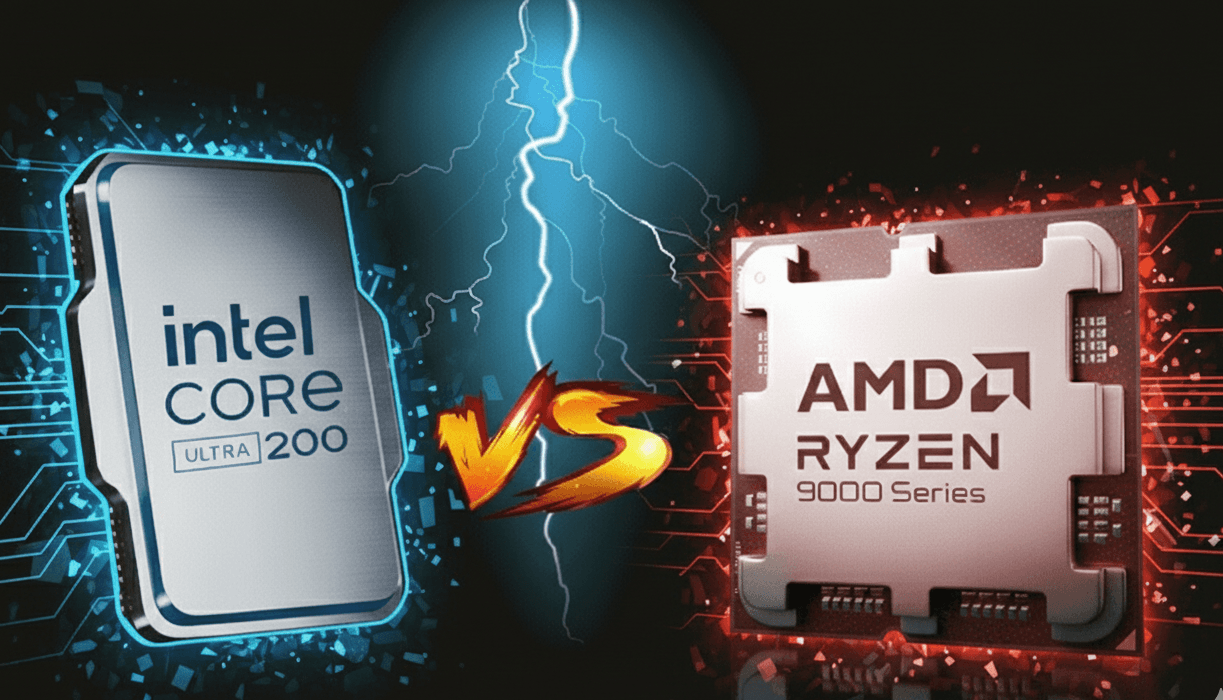
Entering the end of 2025, the desktop computing landscape is once again at a crucial point. Two semiconductor giants, Intel and AMD, have launched (or are about to widely release) their latest processor architectures: Intel with Arrow Lake and AMD with Zen 5. This is not just a battle of benchmark numbers; it’s a battle of design philosophies, manufacturing innovation, and long-term visions of how we will interact with computers in the age of artificial intelligence.
Intel Arrow Lake: Hybrid Architecture Evolution and Local AI Dominance
Intel Arrow Lake, which has already begun to populate the market or will be available soon in late 2025, represents a significant evolution of the hybrid architecture strategy that Intel previously introduced. Following the success of Raptor Lake and Raptor Lake Refresh, Arrow Lake is built on the foundation of Intel 20A process technology or a combination of tiles from various foundries, promising much better power efficiency and transistor density. This is a crucial step, given the intense competition in terms of power-per-watt.
Key Innovations Behind Arrow Lake: Why Does It Matter?
- New Microarchitecture (Lion Cove P-cores, Skymont E-cores): Arrow Lake features performance cores (P-cores) with Lion Cove architecture and efficiency cores (E-cores) with Skymont. P-cores are designed for substantial improvements in IPC (Instructions Per Clock) — how much work a processor core can complete in one clock cycle — for responsive single-thread performance for gaming and demanding applications. Meanwhile, E-cores with Skymont architecture focus on massive energy efficiency, important for multitasking and background tasks without draining power, and enabling longer battery life on laptops. A strong rumor also mentions the potential absence of Hyper-Threading on P-cores, a strategic shift that can optimize core design for maximum IPC with the potential to slightly sacrifice multi-thread throughput in some scenarios, but simplifies thread scheduling.
- Next-Generation, More Powerful NPU: One of the most prominent features of Arrow Lake is the integration of a much more powerful and efficient NPU (Neural Processing Unit). Why is this important? In the era of Windows Copilot and increasingly prevalent AI applications, the NPU is responsible for accelerating the inference of AI models locally. This means AI processing such as image denoising, real-time voice transcription, or AI-based security features can be performed on your device without the need to send data to the cloud. This enhances privacy, reduces latency, and frees up CPU/GPU resources for other tasks, while also opening the door to more intelligent and responsive AI application innovation.
- Platform & Ecosystem: Arrow Lake will use the new LGA1851 socket, signaling a new era of motherboards and chipsets. With exclusive support for DDR5 memory, systems will gain higher memory bandwidth, crucial for data-intensive applications and modern gaming.
AMD Zen 5: Total Overhaul for Peak Performance and Scalability
On the other side of the spectrum, AMD with its Zen 5 architecture — already available on the market through the Ryzen 8000 series (Granite Ridge for desktop and Strix Point for mobile APUs) in Sept 2025 — claims to be a major overhaul of the highly successful Zen architecture. AMD has consistently pushed the boundaries of performance with Zen, and Zen 5 is designed to reclaim the performance crown in various segments. This is not merely an improvement, but a fundamental redesign.
Breakthroughs at the Heart of Zen 5: What’s the Impact on Us?
- New Microarchitecture Design & Manufacturing Process: Zen 5 is manufactured using the more advanced TSMC N4 or N3 nodes, allowing for denser transistors, better energy efficiency, and higher frequencies. AMD promises to deliver substantial single-thread and multi-thread performance leaps, with rumors indicating double-digit IPC improvements, which will have a direct impact on the execution speed of applications and the gaming experience. This overhaul includes improvements to the front-end (smarter branch prediction units) and the back-end (increased execution width and capacity) to process more instructions faster per cycle.
- Cache and Memory Optimization: Improvements to the cache hierarchy are a major focus of Zen 5. Larger and faster caches (L1, L2, L3) will reduce data access latency to main memory, which is essential for data-sensitive workloads such as AAA gaming and scientific computing.
- Mature Chiplet Technology Advantages: AMD continues to leverage its reliable chiplet technology. Why is this crucial? This modular approach allows AMD to combine various components (CPU cores, I/O) produced separately in one package, resulting in extraordinary scalability, manufacturing flexibility, and cost efficiency to create processors with a high number of cores without sacrificing production yield. This is a strategic advantage in delivering competitive high-core-count CPUs.
- RDNA 3.5/4 Graphics Integration (for APUs): For mobile APU series, Zen 5 (Strix Point) comes with an iGPU based on the RDNA 3.5 or even the newer RDNA 4 architecture, providing integrated graphics performance capable of handling modern gaming at reasonable resolutions, as well as accelerating creative workloads like video editing.
Why This Battle Matters: More Than Just CPUs for Gaming
As someone who has been involved in IT infrastructure and cybersecurity for over two decades, I see this battle between Arrow Lake and Zen 5 as an important indicator of the direction of global computing. It’s not just about who wins the title of “fastest gaming CPU,” but about the technological foundation that will underpin innovation in the years to come:
- Driving Local AI Innovation: The presence of powerful NPUs in both camps (especially Intel) indicates a shift towards on-device AI. This is important for data security (data does not have to go to the cloud), deeper personalization of the user experience, and richer application capabilities without internet dependence.
- Energy Efficiency for the Future: With increasing power consumption, the efficiency of P-cores and E-cores, as well as the optimization of manufacturing nodes, becomes crucial. This impacts the operating costs of data centers, the design of more durable mobile devices, and the commitment to greener computing.
- Architectural Flexibility: Both Intel with its modular tile design and AMD with its chiplets are demonstrating a trend towards architectural flexibility. This allows manufacturers to adapt more quickly to changing market needs, integrate new IPs, and optimize production costs.
- Choice and Competition That Benefits Consumers and Industry: Ultimately, this fierce competition is the best news for all of us. It encourages both companies to continue innovating, offering products with better performance and more competitive prices. From professional workstations, servers, to home PCs, we will gain access to unprecedented computing power, allowing us to do more, faster, and more efficiently.
The battle between Intel Arrow Lake and AMD Zen 5 is not just a new chapter; it is a determinant of how we will work, play, and interact with technology in the next decade. Get ready, because the future of computing is already here.