Who says only expensive cameras can take amazing photos? Turns out, your smartphone has a magician inside.
Let’s be honest, who isn’t annoyed seeing other people’s Instagram photos looking pristine, while your shots in the same conditions look like they’ve been through a clothesline filter? Back in the day, to get a perfect photo, you had to be prepared to carry a camera bag the size of a giant, swap lenses like changing clothes, and pray it wouldn’t rain. But now? Just pull your smartphone out of your pocket, snap, and the result will leave you gaping. How is that possible?
No, this isn’t magic. It’s called computational photography. Sounds very technical, right? Don’t worry, I was also a bit reluctant to hear about it at first. But after I fiddled with it myself, it turns out this is what enables our smartphones to outperform expensive cameras in certain scenarios. So, let’s unpack this ‘magician’ inside your smartphone, without needing any dizzying marketing jargon.
Limitations Actually Drive Crazy Innovation
You see, smartphones are thin. No matter how cool the technology is, there are laws of physics that can’t be broken. The camera sensor is small, the lenses are tiny. It’s like they can only ‘see’ a little light compared to a DSLR camera which has a large body and super wide ‘eyes’. The result? If there’s insufficient light, the output is often grainy (noise) or details get lost in the dark. If there’s a very bright and a very dark area in a single photo, one of them will definitely be ’empty’. Difficult, right?
Well, this is where artificial intelligence, or AI, comes into play. Computational photography is like creating an additional ‘brain’ for your smartphone camera. Instead of just relying on limited ‘eyes’, it uses this ‘brain’ to process image data much more intelligently. It doesn’t just take one photo, but captures many ‘snippets’ of data, which are then combined into a single optimal final result. Simply put, it’s like you’re assembling the best puzzle from several different images.
Effective Techniques That Make Photos ‘Wow!’
Every time you press the shutter button on your smartphone, a ‘magical’ process happens in a fraction of a second. Here are some ‘magic tricks’ that are often used:
- HDR (High Dynamic Range) / Smart HDR: Fighting Bright Lights & Pitch Darkness Simultaneously
Ever taken a photo of a mountain landscape in the morning, where the sky was so bright it looked completely white, but the mountain itself was dark? Well, that’s a high contrast problem. Smartphone cameras now have a champion called HDR.How it works: When HDR mode is active, your smartphone takes several photos simultaneously with different brightness levels. Some are very bright (overexposed), some are normal, and some are very dark (underexposed). Then, the AI ‘borrows’ the best details from each photo. Clear cloud details from the dark photo, subject details from the normal photo, and shadow details from the bright photo. The result? A single photo with an eye-pleasing light balance. - Night Mode: Conquering Darkness Without a Tripod
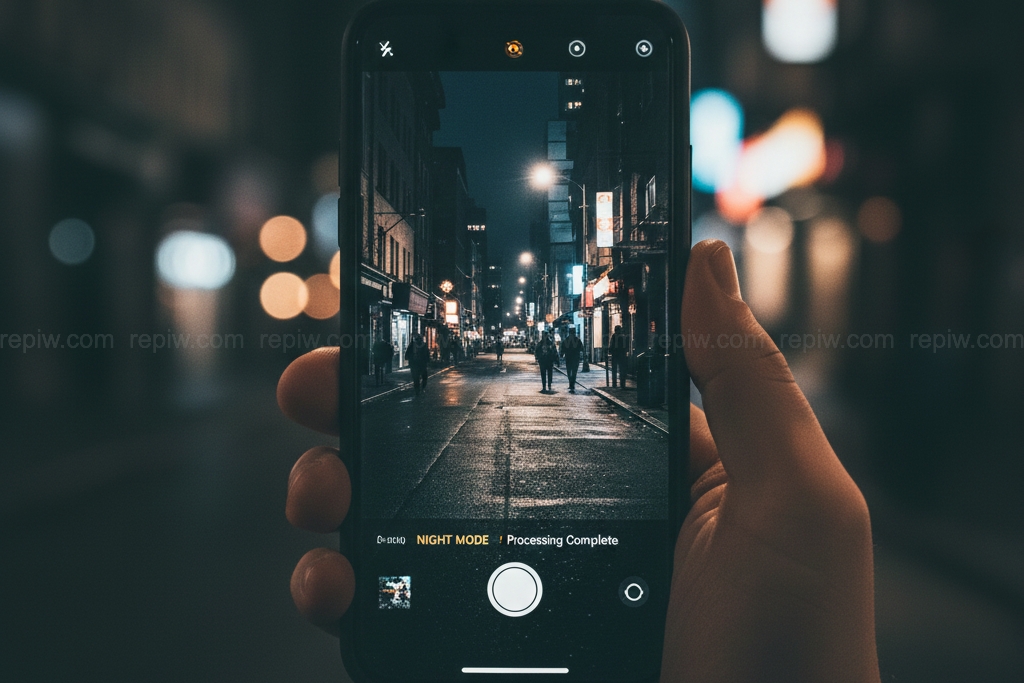
This is perhaps the feature with the most noticeable impact for me. Back then, to take night photos, you had to use a tripod to avoid shaking and have a long exposure. Now? Just hold your smartphone, turn on night mode, and witness the magic.How it works: When night mode is active, your smartphone camera takes a series of photos over several seconds. Even if your hands try to be as steady as possible, there will always be some slight vibration. The AI aligns all these short ‘recordings’, selecting the sharpest parts from each frame to eliminate blur effects. Even cooler, it also collects all the light data from all these frames. The result? Night photos that are much brighter, with visible details, and a drastic reduction in noise. It’s like magic, dark turns to light but remains natural. - Portrait Mode & Fake Bokeh: Making the Subject ‘Pop’
You’ve surely seen photos of people with blurred backgrounds, or bokeh, right? This makes the subject the main focus and look professional. In the past, this could only be done with expensive cameras and special lenses.How it works: If your smartphone has more than one camera (e.g., wide and telephoto), it utilizes the difference in their viewing angles to create a sort of ‘depth map’. This map tells which is the main object and how far the background is. The chipset (its brain) then ‘fakes’ a gradual blur effect in the background. For smartphones with only one camera, they use sophisticated machine learning tricks to ‘recognize’ who or what the main object is, and then digitally separate it from the background before blurring it. - Deep Fusion / Pixel Binning: Automatic Pixel-Level Correction
This is a technique that usually runs automatically in the background, without you needing to touch anything. It’s called ‘Deep Fusion’ or ‘Pixel Binning’, depending on the smartphone brand.How it works: Before you press the shutter button, the camera has already saved several image frames. When you press the button, the camera analyzes these frames, including those taken with a super short exposure to freeze motion, and those with longer exposures to capture detail. The AI then compares and ‘mixes’ the data from each pixel in each frame. This ‘fusion’ process ensures that each pixel gets the best detail and texture, while minimizing noise. The result is a super sharp and detailed image.
So, Why Is This Important to You?
In short, computational photography is changing the way we take photos. It’s no longer just about how good your camera’s ‘eyes’ (sensor and lens) are, but how smart the ‘brain’ (software and AI) behind it is. Physical limitations that were once obstacles are now driving innovation to create extraordinary software solutions. The result? Millions of people worldwide can get high-quality photos with just a smartphone in their pocket.
The Future: More Powerful Video, More Editing Freedom
What’s exciting is that this technology continues to evolve. We’re already starting to see ‘Cinematic Mode’ on some smartphones that can create rack focus effects in videos like in movie theaters. In the future, don’t be surprised if video quality in low-light conditions becomes even more stunning, or if their dynamic range becomes wider. There’s even a possibility that we’ll be able to edit videos or photos as if changing the lighting or objects after the photo has been taken, thanks to generative AI.
Computational photography is tangible proof that the collaboration of hardware and software can yield unexpected results. For photography purists, this might be ‘impure’, but for us who need great results without the hassle? It’s a blessing.
Review Verdict: Buy or Skip?
Essentially, if you’re looking for a new smartphone and expect good photo results without needing to fiddle with settings, make sure it has a capable computational photography ‘brain’. Features like smart HDR, powerful Night Mode, and accurate Portrait Mode are key indicators. The image processing capabilities of its chip are also crucial. So, it’s definitely worth it for those who want amazing photo results without becoming a makeshift photographer carrying a ton of gear.