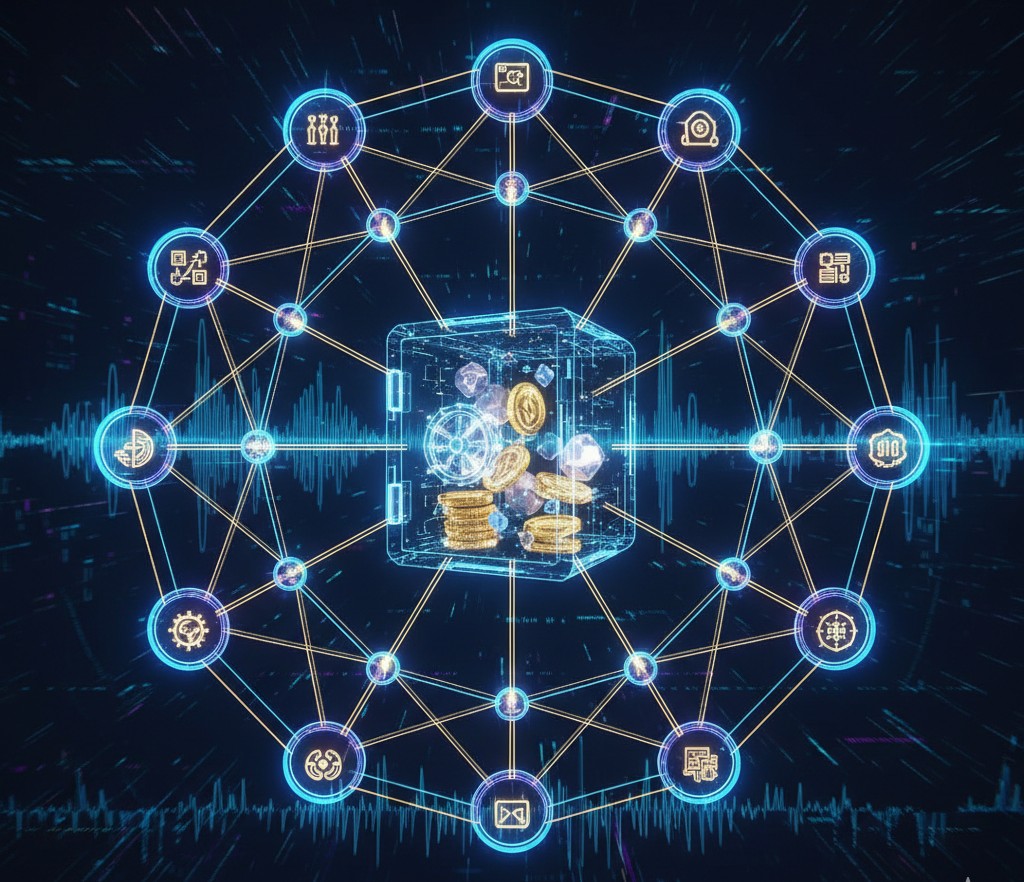
The world of technology never stops spinning, and now we are navigating the Web3 phase, which promises decentralization. Amidst this wave, a concept has emerged that boldly seeks to reshape how we organize: DAO, or Decentralized Autonomous Organization. Don’t imagine office structures with cubicles and managers; forget rigid hierarchies. DAOs are different, and Repiw will dissect them to the bone.
What exactly is a DAO? Imagine an investment club, an artist community, or even a mini-nation, but all its rules are clearly written in transparent program code, and decisions are in the hands of all its members, not a select few well-dressed board members. This isn’t a utopia, but a digital entity that lives on the internet, operates independently, and coordinates through a set of rules embedded within the blockchain.
Dissecting the Core Architecture: Decentralization, Autonomy, and Organization
Decentralization: When Power is Distributed Evenly
In conventional companies, power is often centralized, concentrated in the hands of the CEO or C-suite. It’s like putting all your eggs in one basket; if one person at the top makes a wrong decision, the impact can be felt all the way down to the roots. DAOs embrace a different philosophy. They distribute that power to all their members. No single entity can arbitrarily change rules or misuse funds without collective approval.
Every crucial decision is recorded and validated on the blockchain, a kind of perpetual digital ledger that cannot be manipulated and can be viewed by anyone. You can directly feel how this transparency builds a foundation of trust, where every voting click or fund movement is clearly recorded. The goal? To create a system that is more democratic, fair, and resilient against censorship or unilateral intervention.
Autonomy: Smart Contracts as Digital Constitutions
The ‘autonomous’ aspect of DAOs is powered by smart contracts. These are not just agreements on paper; they are computer programs residing on the blockchain that automatically execute agreements once certain conditions are met. Think of it like a giant vending machine: you insert coins (meet the conditions), and the drink (the outcome) comes out immediately, without needing a cashier or bureaucracy.
The rules of a DAO, its governance structure, and how its treasury is managed are all coded into these smart contracts. Once launched, these contracts will run on their own according to the established guidelines, without human intervention to enforce them. This completely eliminates the need for intermediaries and bureaucracy, making the organization’s operations far more efficient. You can feel the cold, unemotional efficiency of a system that operates based on pure code logic.
Organization: Collective Purpose in a Decentralized Network
Despite being decentralized and autonomous, a DAO is still an organization with a shared purpose. Its members—who are typically holders of governance tokens—work together to achieve that goal. They can submit proposals, such as, “Let’s invest treasury funds in project X!” and then token holders cast their votes. Your voting weight? It’s often proportional to the number of tokens you hold. This is no longer just about contributing; it’s about actively shaping the direction of the organization you own.
How DAOs Work: From Proposal to Code Execution
How does a DAO ‘live’ and move? Here’s the mechanism:
- Rule Creation via Smart Contracts: A core developer team builds the smart contract that forms the backbone of the DAO. This includes everything from voting mechanisms, mission statements, to how the treasury is managed.
- Funding Phase & Power Distribution: To raise funds and distribute power, DAOs typically sell governance tokens. These tokens grant voting rights and can be traded on crypto markets. The collected funds? They go directly into a treasury controlled by the smart contract, not into anyone’s personal bank account.
- Decision Making via Proposals: Once the DAO is operational, any significant change must go through a proposal process. A member can create a proposal, such as, “Allocate funds for new feature research.”
- Community Voting: Token holders then cast their votes. If the proposal reaches quorum (minimum number of votes) and is approved, the smart contract will automatically execute the proposed action. It’s like a giant ‘enter’ button pressed by collective consensus.
Security and Privacy at the Heart of DAOs
Talking about DAOs without touching on security and privacy would be a fatal oversight. The inherently transparent nature of blockchain means every transaction and voting result is publicly recorded. This is a double-edged sword. On the security side, full transparency means everyone can audit fund movements and decisions, creating a hard-to-penetrate layer of defense against internal corruption.
However, on the privacy front, although real identities are often masked by wallet addresses, activity patterns and token holdings can become a rather clear digital footprint. For some, this can be a concern, especially if they don’t want their financial participation to be too public.
The biggest security threat to DAOs is not the blockchain system itself, but the quality of the smart contract code. A small loophole in the code can become a gaping hole exploited by hackers, as tragically happened with ‘The DAO’ in 2016, resulting in millions of dollars in losses. This is a stark warning: the power of smart contract autonomy also means it is unforgiving if its code is flawed. There’s no ‘undo’ button after execution. Code auditing is a vital foundation, not just an add-on.
Final Analysis
DAOs are not just a fleeting trend; they carry revolutionary potential in governance. With full transparency and equitable distribution of power, they offer the promise of true democracy in digital organizations. This is a solid investment in an organizational model that could become the new standard, especially for projects that require public trust and boundless global collaboration beyond geographical boundaries.
However, Repiw also sees real challenges. Regulatory uncertainty across various jurisdictions remains a shadow looming over mass adoption. The vulnerability of smart contracts is a specter that requires rigorous testing and auditing; a DAO must have swift repair mechanisms in place if exploitation occurs. Furthermore, governance efficiency—where every decision must go through voting—can be slow, and potentially subject to ‘voter apathy’ or reluctance to participate.
Nevertheless, with maturing technology and evolving collective understanding, DAOs have a high performance-to-price ratio for the future of collaboration. This is a bold experiment that is reshaping the definition of ‘organization.’ Repiw sees this as valid for long-term adoption, provided its builders are serious about addressing security vulnerabilities and refining governance mechanisms. We haven’t seen its peak yet, but its foundations are firmly in place.